DJ Quik, The Book of David
By Jayson Greene
For more than 20 years, DJ Quik has been the secret ingredient in the broth. Whether you know it or not, the gifted West Coast producer/rapper has worked on dozens of L.A. gangsta rap classics you've drunkenly screamed along to, often without even a liner-note credit to show for his efforts. Pop music's grumbling cast of neglected innovators is long, but Quik doesn't quite fit with that crowd: He's released platinum and gold records, as well as helped craft them for Tupac, Snoop, and Dre. Instead, he's stuck in that weird purgatory between Unknown Legend and Not-Quite-Star. It's a situation that could bog you down if you let it. But if you decide, one day, that you simply do not care anymore, something amazing can happen: You realize you can do whatever the hell you want.
This realization has been dawning in real time in DJ Quik's music recently. On BlaQKout, his 2009 collaboration with fellow West Coast warrior Kurupt, he experimented with stylistic detours from electro to dub, letting his free-associative musical imagination run wild. On the surface, The Book of David feels more straightforward. A rich stew of warm disco, grown-and-sexy R&B, and classic g-funk, it sounds engineered to waft out over barbecues. But it's also riddled with idiosyncrasies: songs that dissolve into deep-dub fade-outs, vocal samples that pop up in unexpected places, astonishing statements of raw heartbreak and anger. It's as weird as it is crowd-pleasing, and it underlines what BlaQKout suggested: Unencumbered by commercial expectations, Quik is making some of the most inventive music of his career.
Quik has always been quirkier than his gangsta-rap peers-- underneath the monstrous knock of his drums, he's snuck in all manner of odd little details. On The Book of David, though, he's a full-blown mad scientist of trunk-rattle. "Fire and Brimstone", the album's opening track, lurches out of the gate with a stumbling drum pattern. It's a pulverizing track that could transform a passing Jeep into a noise-disturbance complaint, but it's also a sprawling grid of counter-rhythms oddly similar to the rhythmic map of Radiohead's "Bloom". (Seriously.) "Poppin'", meanwhile, feels like a random collection of unrelated sounds accidentally colliding to form a perfectly coherent groove.
If any of this sounds wonky or cerebral, don't worry-- The Book of David is a pleasure-first listening experience, and Quik deploys each of his tricks with a showman's flair. "Hydromatic" loops an intoxicating vocal sample around some bone-jarring piano stabs and New Orleans brass-band blurts, and that's before the head-spinning syncopated hand-claps glide in. "Killer Dope" rolls in on a regal fanfare of French horn pads and jazz-inflected pianos. On that song, Quik brags about his ability to simultaneously rhyme and play his piano live; it's a telling boast, revealing the old-school funk producer Quik is in his heart. On The Book of David, you feel his keen musical intelligence-- and his humble pride in his talent-- presiding.
Most rapper/producers struggle to be as memorable on the mic as they are in the booth, but not Quik. On BlaQKout, he effortlessly lapped frowning technical lyricist Kurupt, and given a sprawling 70-minute album to hold down, he makes for durably fascinating company. His word choices-- meticulous and hilarious-- land somewhere left of your expectations, making him the most vivid presence on each song he's on. "I got wordplay acumen/ And I've had it since you was in grade school watchin' the janitor vacuumin'," he informs us on "Babylon". When he doles out insults, it's with a sense of school-teacherly calm (he's "a dignitary, you're a lowly beggar," he says on "Fire and Brimstone"), and even when Quik summons true venom, his voice never rises above the level of casual conversation.
Most of that venom on The Book of David is directed, as it has been for most of his career, at an intimate place: his own family. "Ghetto Rendezvous" ("I hate you so much it just shows/ I hate you more than Michael hated Joe") is directed to his own sister, whom he almost did 10 years in prison for pulling a gun on when she allegedly tried to kidnap his children. It's a horrific story, the kind of dirty laundry some rappers would air as a perverse badge of honor (see: Game, The). But Quik has no interest in battering us with his personal pain; he just wants to tell us about it. So he slips it in easily among the boasts, the jokes, and the party jams. In that way, David mimics the texture of real life-- jokes and confessions, partying and pain, all mixed up together.
The Book of David emanates this decidedly zen confidence and ease at every level. Quik has a lifetime's worth of career relationships and unlimited lines of credibility to draw on, but he shows zero interest in crowding his tracks with guest-verse favors called in from his more famous friends to wiggle closer to the mainstream. The features on David-- relative no-names like Jon B., BlaKKazz K. K., local legends like Suga Free, over-the-hill West Coast rappers like Ice Cube and Kurupt-- are his compatriots, people he's worked with for years, and they slot into his overall work exactly as he sees fit. When you've exerted the kind of unacknowledged influence on your art form that Quik has, bitterness can take hold easily. But Quik has chosen a wiser route: He's created a tiny island on which he is king.
Book Review
Book Review
L.A. Raw
By Barry Gifford;
Published: June 5, 1994
BLACK BETTY By Walter Mosley. 255 pp. New York: W.W. Norton & Company. $19.95.
IN "Black Betty," Walter Mosley writes like a boxer who throughout his career has campaigned as a lightweight or welterweight and now, because he can no longer shed the necessary pounds, is forced to fight as a middleweight. To go the full 12 rounds a good fighter has to pace himself, and Mr. Mosley, in his fourth novel about the black Los Angeles private eye Easy Rawlins, still seems slightly unsure, not of his capacity to endure the distance but rather of just how far to extend himself per round. However, Mr. Mosley beats hell out of most of today's contenders for consideration as a top-ranking writer in the mystery division.
Boxing is called the sweet science; Mr. Mosley has a sweet ear. "I rapped my knuckles on the front door. It was fabricated from many layers of wood. So many layers that I couldn't get a sure knock. The sound I did make was nothing more than the rustling of kisses in a close hallway at night." That's Easy Rawlins talking, running down a lead on an old acquaintance of his, Elizabeth Eady, also called Black Betty, who has turned up missing.
The year is 1961, the geography Los Angeles and the surrounding desert. Easy has been living off his real estate investments, the proceeds of which have dwindled lately, forcing him to take on this outside work. Besides his own, he has two other mouths to feed, those of his adopted children: 15-year-old Jesus (Juice), a mostly mute champion prep-school long-distance runner, whom Easy saved from further abuse and "a life of child prostitution before he was 3," and Feather, a little girl whose white mother was murdered by her own father for the crime of having borne a black child. Jesus has chosen to remain silent, speaking occasionally only to his sister, never to Easy Rawlins, who admits his sadness regarding this situation one night to Feather while they're watching "Dobie Gillis" on television. "Why won't Juice talk to me?" Easy asks her. "Because he don't like you to talk to, Daddy," she answers, adding, "But that's O.K. because he love you too."
Easy first encountered Black Betty in their native Houston, when he was 12 years old. Betty was "a great shark of a woman. Men died in her wake. . . . Back then there weren't too many of your colored men who could afford a steady diet of Betty. Many a night, yesterday's boyfriend went up against tonight's man. Betty could draw blood three nights in a week, and if it ever bothered her she never let it show." The preadolescent Easy had spotted her "sashaying down the wooden sidewalks of Houston's Fifth Ward" adorned by "black lace, gloves and fur." She "smelled so good that I forgot who I was." When the young Easy had told Betty how pretty he thought she was, she had bestowed upon him so powerful a soul kiss that he had fallen down. When a slimy white private eye named Saul Lynx asks the now middle-aged Easy if he knows Black Betty, Rawlins feigns ignorance, but the memory of her flaming lips has permanently scored his brain pan. "I would havejumped out of a window for her kiss," Easy confesses to the reader.
Betty left Houston after a series of nefarious activities and has ended up, 25 years later, in Beverly Hills, working as a domestic. Saul Lynx tells Easy that Betty has disappeared and her boss wants her back. Lynx's sources say Rawlins is the man to track the lady down. Easy is not wild about taking the gig, but times being what they are, and the woman being not just any woman, he signs on.
What follows is no ordinary caper. In short order, Rawlins has to deal with a homicidal sidekick, Mouse; Betty's strange, off-key half brother, Marlon; a cowardly, lizardlike bookie named Jackson Blue and his paranoid triggerman, Ortiz; Alamo Weir, "the kind of crazy animal who lied, cheated and killed"; and dozens of other odd creations. Underscoring this scenario is Easy's constant sorrowful longing for Edna, his daughter, who lives with her mother, Regina, Easy's ex-wife, in Mississippi.
The real value of Walter Mosley's novel lies in his digressions and social shorthand. For example, take this riff on Los Angeles: "You could tell by some people's houses that they came to L.A. to live out their dreams. Home is not a place to dream. . . . Home meant that everybody already knew what you could do and if you did the slightest little thing different they'd laugh you right down into a hole. You lived in that hole. . . . After a while you either accepted your hole or you got out of it. There were all kinds of ways out. You could get married, get drunk, get next to somebody's wife. You could take a shotgun and eat it for a midnight snack. Or you could move to California."
THERE are echoes of "Farewell, My Lovely" in "Black Betty," but that doesn't make Walter Mosley the black Raymond Chandler, any more than echoes of "The Real Cool Killers" make him the heir to Chester Himes. Every modern fighter who can hook off the jab and circle south owes a debt to Sugar Ray Robinson, but that doesn't mean much if he hasn't got the heart to go with it -- and nobody will ever accuse Walter Mosley of lacking heart. This man comes at you kind of herky-jerky; his words prowl around the page before they pounce, knocking you not so much upside the head as around the body, where you feel them the longest.
"Poor men are always ready to die," Easy says at one point. "We always expect that there's somebody out there who wants to kill us. That's why I never questioned that a white man would pull out his gun when he saw a Negro coming. That's just the way it is in America." LOCKED UP
They put me in a sort of meeting room with bars. There was a long beech table surrounded by beech chairs on a buffed parquet pine floor. Through the bars on the window I could see down onto Santa Monica Boulevard. The cars were going about their business. Not one of those drivers knew that I was bunged up in jail for no reason. And if any of them had found out they wouldn't have cared. And even if they did care there wasn't any help for me. . . .
I watched the sun go down and the car lights come on. I banged on the door and yelled a couple of times but nobody came. . . .
The cops came in when I'd given up trying. My gut felt like there was a bowling ball lodged inside. My tongue was dry. My stomach had given up grumbling and died.
There were three of them. A little man in gray trousers and a white shirt with the sleeves rolled up past his bony elbows. He wore gold-rimmed glasses and had thin, milky skin with blue veins just below the surface. There was a uniformed cop dressed in a black uniform. He had ironed his uniform that day. By the way he held his hat under his left arm, military style, I believed that he ironed it every morning. He was a tall man, well built and self-assured. His brown hair and brown eyes jarred slightly with the paleness of his skin.
But it was the third man whom I paid attention to. He was at least six and a half feet tall. . . . His dark blue pants might have been police-issue but his white shirt was spun fine and tailored. His collar was open at the throat.
His face was busy. His eyes moved over me quickly and then around the floor, then back to me. His lips went between the beginning of a friendly grin and a sneer.
If I had seen this man walking my way on the street I'd've crossed to the other side.
"Styles," the jumpy-faced giant said, pointing at his own chest. "Commander Styles." Commander. From "Black Betty."
To Pimp a Butterfly
- To Pimp a Butterfly
- Kendrick Lamar
- Top Dawg/Aftermath/Interscope
The Compton MC's second major-label album is a masterpiece of fiery outrage, deep jazz and ruthless self-critique
The party begins in earnest with George Clinton's blessings and bassist Thundercat's love for Bootsy Collins. "Wesley's Theory" is a disarming goof that's also a lament for the starry-eyed innocence lost to all winners of the game show known as Hip-Hop Idol. "Gather your wind, take a deep look inside," Clinton says. "Are you really who they idolize?" Lamar's got plenty of jokes and jeremiads to launch at himself, us and those malevolent powers that be. "I want you to recognize that I'm a proud monkey," he raps later on. "You vandalize my perception, but can't take style from me."
He's also made hella room for live jazz improv on this furthermucker, from the celestial keys of virtuoso pianist Robert Glasper to the horns of Terrace Martin and Kamasi Washington to Thundercat's low end. Black Musicians Matter majorly here – their well-tempered orchestral note-worrying a consistent head-nod toward Sun Ra, which producers including Flying Lotus and Lamar's right-hand Sounwave smush into a lush volcanic riverbed of harmonic cunning and complexity. Only a lyricist of Lamar's skills, scope, poetics and polemics would dare hop aboard it and dragon-glide. His virtuosic slam-poetic romp across bebop blues changes on "For Free?" harkens back to LA's Freestyle Fellowship.
Clearly, this is Lamar's moment to remake rap in his own blood-sick image. If we're talking insurgent content and currency, Lamar straight up owns rap relevancy on Butterfly, whatever challengers to the throne barely visible in his dusty rear-view. He relishes and crushes the gift he's been handed by CNN in the national constabulary's now weekly-reported racist tactics, 21st-century apartheid American style: "It's a new gang in town, from Compton to Congress/…Ain't nothing new but a flow of new Demo-Crips and Re-Blood-licans." This tactic is nowhere more resonant than on the studio-rigged beyond-the-grave convo with 2Pac he conjures up on ''Mortal Man,'' letting Pac deliver the album's most-fatalist mad-prophetic zinger: ''Next time it's a riot, there's gonna be bloodshed for real. . .I think America thinks we was just playing, but it's gonna be murder. . .like Nat Turner 1831 up in this muthafucka.''
He's also made hella room for live jazz improv on this furthermucker, from the celestial keys of virtuoso pianist Robert Glasper to the horns of Terrace Martin and Kamasi Washington to Thundercat's low end. Black Musicians Matter majorly here – their well-tempered orchestral note-worrying a consistent head-nod toward Sun Ra, which producers including Flying Lotus and Lamar's right-hand Sounwave smush into a lush volcanic riverbed of harmonic cunning and complexity. Only a lyricist of Lamar's skills, scope, poetics and polemics would dare hop aboard it and dragon-glide. His virtuosic slam-poetic romp across bebop blues changes on "For Free?" harkens back to LA's Freestyle Fellowship.
Clearly, this is Lamar's moment to remake rap in his own blood-sick image. If we're talking insurgent content and currency, Lamar straight up owns rap relevancy on Butterfly, whatever challengers to the throne barely visible in his dusty rear-view. He relishes and crushes the gift he's been handed by CNN in the national constabulary's now weekly-reported racist tactics, 21st-century apartheid American style: "It's a new gang in town, from Compton to Congress/…Ain't nothing new but a flow of new Demo-Crips and Re-Blood-licans." This tactic is nowhere more resonant than on the studio-rigged beyond-the-grave convo with 2Pac he conjures up on ''Mortal Man,'' letting Pac deliver the album's most-fatalist mad-prophetic zinger: ''Next time it's a riot, there's gonna be bloodshed for real. . .I think America thinks we was just playing, but it's gonna be murder. . .like Nat Turner 1831 up in this muthafucka.''
But Lamar's own fears of assuming a messiah position are upfront and personal. "I been wrote off before, I got abandonment issues," he says on "Mortal Man." "How many leaders you said you needed then left 'em for dead?/Is it Moses, is it Huey Newton, or Detroit Red?" You can imagine Chuck D or Dead Prez going in as hard and witty against white supremacy as Lamar does on "The Blacker the Berry" and "King Kunta" – but you can't picture them exposing the vulnerability, doubt and self-loathing swag heard on ''Complexion (A Zulu Love)," "u," "For Sale?" and "i." What makes Lamar's bully pulpit more akin to Curtis Mayfield's or Gil Scott Heron's than any protest MC before him is the heart worn on his hoodie's sleeves.
To Pimp a Butterfly is a densely packed, dizzying rush of unfiltered rage and unapologetic romanticism, true-crime confessionals, come-to-Jesus sidebars, blunted-swing sophistication, scathing self-critique and rap-quotable riot acts. Roll over Beethoven, tell Thomas Jefferson and his overseer Bull Connor the news: Kendrick Lamar and his jazzy guerrilla hands just mob-deeped the new Jim Crow, then stomped a mud hole out that ass.
Film Review
Comments

Film Review
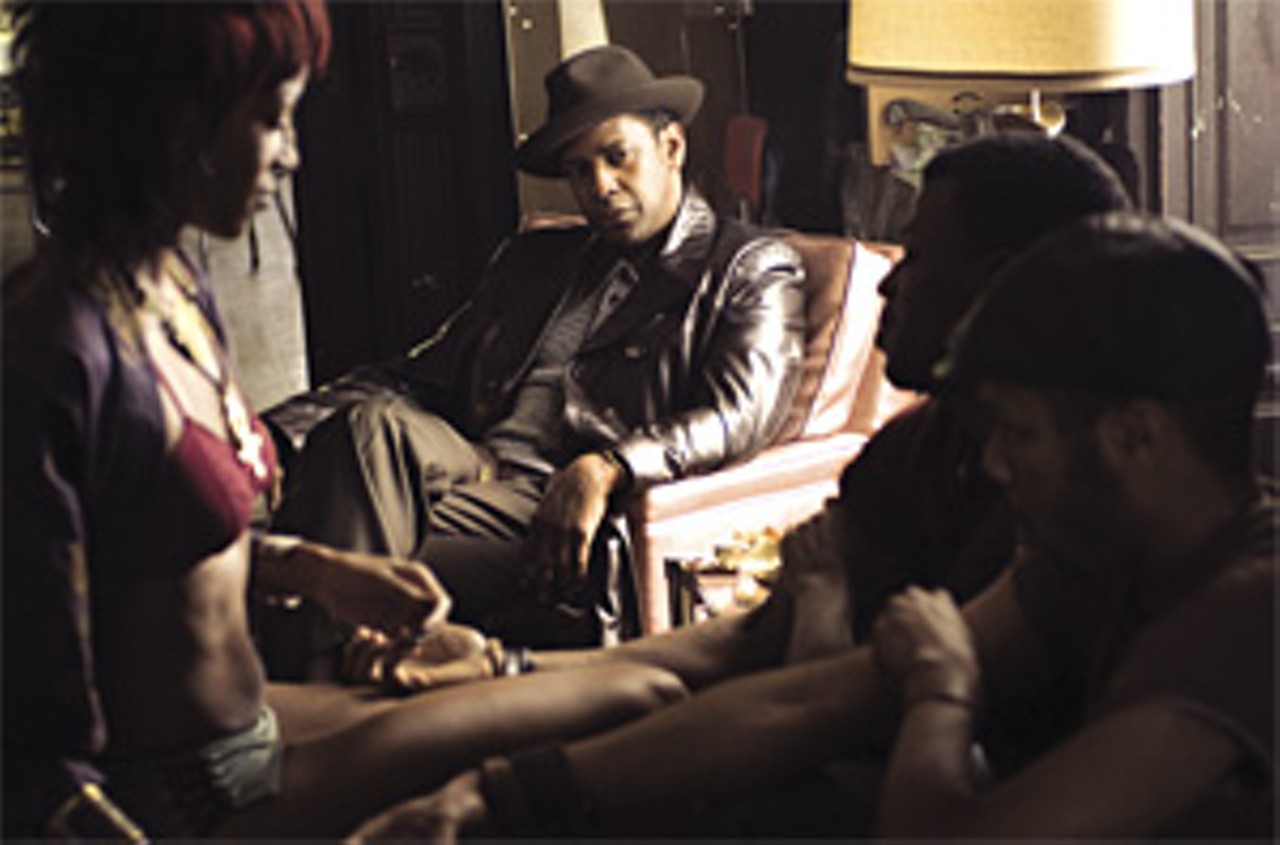
- DAVID LEE
- A thug and a gentleman: Denzel Washington as the circumspect badass.
American Gangster is a movie with obvious gravitas and a familiar argument: Organized crime is outsider capitalism. As archetypal as its title, Ridley Scott's would-be epic aspires to enshrine Harlem dope king Frank Lucas in Hollywood heaven, heir to Scarface and the Godfather. Or, as suggested by the Mark Jacobson article on Lucas that inspired the movie, a real-life Superfly.
Ambitious as American Gangster is, it's well suited to Denzel Washington's particular star quality — the circumspect badass. Washington plays Lucas as a combination of ruthless thug and gentlemanly striver. His two sides are established in a murky opening sequence when Lucas, factotum to old-school crime boss Bumpy Johnson, torches a guy in one shot and tosses Christmas turkeys to the crowd in the next.
It's 1968, and Bumpy is complaining that corporations are pushing out the middleman. He then drops dead in the very chain-store outlet that prompted his disquisition, leaving Lucas to create a new empire — by eliminating the middleman. Rather than dealing with the mob, Lucas figures out a way to import high-grade heroin direct from Indochina. Then he takes Harlem by storm, selling smack that's twice as good for half the price under the label Blue Magic.
Scott's Lucas is a more attractive, if less hypnotic, than the character profiled by Jacobson. (The writer notes that, upon hearing tapes of his conversations with Lucas, his wife remarked, "Oh ... you're doing a story on Satan.") To balance the moral equation, Steven Zaillian's script introduces a Lucas nemesis in the form of actual police detective Richie Roberts (Russell Crowe). As Lucas is a visionary, Roberts is a man of crazy integrity. Busting a bookie, he finds a car stuffed with unmarked bills and actually brings it in as evidence — causing his partner, soon to be revealed as a drooling junkie, to moan: "I'm a leper because I listened to you and turned in a million bucks."
The world capital of smack and police corruption — such was disco-era New York. Still, for all of American Gangster's discreet period markers and cleverly cobbled-together locations, it doesn't get the period's putrid exhilaration — the sense of irreversible decay and giddy disorder. Scrupulously academic, it does acknowledge the key texts of the day: Scott recycles the theme from Across 110th Street, references Sidney Lumet's Prince of the City, and draws on the quintessential New York dope opera so closely that his movie might have been subtitled The "French Connection" Connection. Albeit directed with suave, high-powered panache, American Gangster lacks The French Connection's messy human drama and, a choreographed final bust notwithstanding, thrill-machine set pieces. The movie never spins out of control.
American Gangster functions on parallel tracks: As Roberts recruits a posse of lowlife cops, so Lucas brings his brothers up from North Carolina to help in the business. As the cop's marriage falls apart, the gangster treats his wife, Miss Puerto Rico 1970 (Lymari Nadal), like a queen — not to mention his mother (Ruby Dee). Further, both men are humiliated and threatened by the predatory animals of the NYPD's corrupt Special Investigations Unit. American Gangster and Honest Cop, each played by an Oscar-winning tough guy, finally converge when Roberts stakes out the Ali-Frazier fight and, spotting the self-effacing Lucas ringside in an uncharacteristic sable coat, has to wonder: "Who the fuck is that guy?"
Who indeed? Lucas is self-made with a vengeance, a cold-blooded killer and warm-hearted family man in one tightly wound package. It's one of the movie's running gags that nobody — certainly no white person save Roberts — seems able to understand that Lucas actually works for himself. American Gangster more than makes its point regarding his entrepreneurial spirit. But Roberts is actually more enigmatic: What makes him so irrationally honest? Could it be the same thing that inspires Lucas? Late in the movie, the gangster dodges an assassin's bullet and waxes indignant: "I ain't running from nobody — this is America."
Marc Levin's current documentary Mr. Untouchable, a portrait of Lucas's better-known rival Nicky Barnes, shares American Gangster's logic in presenting its subject as a natural-born, all-American business genius. Barnes too brags about his professional operation and high-quality shit, dismissing Lucas and his family as rubes: "They acted country and they dressed country." The corresponding cameo in American Gangster is a mirror image. When Lucas discovers that Barnes (broadly played by Cuba Gooding Jr.) is slapping his Blue Magic brand on inferior smack, he confronts his competitor and, with all the indignation of an idealistic M.B.A., accuses him of "trademark infringement."
That's not the only grotesque irony to be found in American Gangster, although at 157 minutes, the movie is a tad leisurely in letting the audience in on Lucas's secret dope-smuggling method — a social metaphor that gives the notion "wrapped in the flag" a whole new meaning.
Bad Religion, The Empire Strikes First
By J.H. Tompkins
I walked outside before dawn one day last fall in Redlands, CA to find a firestorm racing across the nearby hills, leaving a ghostly crimson light flickering in and out of picture windows and windshields, and lending an eerie glow to the early morning fog. The inferno seemed a horribly apt fit for the historical moment-- a kind of purification by fire delivered to a nation choking on official lies, war and joblessness. Greg Graffin and Brett Gurewitz of Bad Religion, the twenty-something year-old L.A. punk band, were paying attention; a few weeks later, they went into the studio to record the searing "Los Angeles Is Burning", a grim celebration of environmental rape and the subsequent payback.
That's just one great moment from Bad Religion's The Empire Strikes First, 14 songs that are fresh, focused, and absolutely alive in the way that great rock 'n' roll energizes everything it touches. It's been a long road from their early-80s beginnings, but these days, the primary concerns of Graffin and Gurewitz are not the band's intricate (and subtle) years-long evolution; they're first and foremost topical songwriters focused on domestic chaos and its global manifestation. Bad Religion is, after all, the outfit that, during the first Gulf War in 1991, shared a Maximum Rock 'n' Roll split seven-inch with radical MIT professor Noam Chomsky, who, like them, is locked into the tense present and dedicated to exposing the forces who lie and disguise to deepen and enforce human misery.
The truth is that after 20+ years, Bad Religion meet the present day not only unfettered by nostalgia, but hardwired into the moment. Fans take the band's growth and standards for granted. It's tempting to say-- though impossible to prove-- that the The Empire Strikes Firstis a such a terrific album because vocalist Graffin and guitarist Gurewitz, the band's most important creative forces, are responding to the death, desolation, and destruction of war, and to the concurrent attacks on the Bill of Rights; it seems more than just a happy accident that the band has just delivered one of its most charged and inspired records in years.
Bad Religion's most important elements are intact here: Graffin's voice and politically informed lyrics, and Gurewitz's imaginative guitar work and background vocals. They wouldn't likely contest the suggestion that the use of simple elements equates to a formula, but the genius of Graffin and Gurewitz is how they take these simple elements and twist them-- unexpected chord changes, short breakdowns, quick drum fills, and increasingly sophisticated, sweet-sounding vocal arrangements so rich you could trade them for military arms.
"Sinister Rouge" is a study in contrasts; a wall of cinematic harmonies comes at you like choir practice in a cave, while Gurewitz's guitar is so close it could touch you (whether you'd like it to or not). "Los Angeles Is Burning" lifts a lesson from the band's own backyard, but "Let Them Eat War" is a classic Bad Religion anthem. Graffin spits out a variation on the theme of old-school punk politics locking arms with the American worker in order to explain how fighting a war serves the interests of the capitalists who keep them down. You'd think (or I would anyway) that any song with the lyric, "You never stole from the rich to give to the poor/ All he ever gave to them was a war/ And a foreign enemy to deplore," should be stopped before it kills again. But don't pull the switch-- the band rocks along at high speed beneath Graffin (and his vocal uses the whole scale), while Gurewitz delivers aggressively graceful, ultra-melodic fills, and sugary harmonies to glue the chorus together.
The irony of it all is that the band's call-and-response vocal arrangements are straight out of a Baptist church house, as are the rich harmonies and the reliance on one man-- in this case, Graffin-- to testify to (and for) the congregation. Bad Religion's magic doesn't stem as much from their political lyrics as from the airtight arrangements and thick, sweet harmonies that bring the lyrics to you, and interestingly, are also the antithesis of the social rebellion the band advocates. A case could be made (and sometimes I make it) that the band resorts to the very things it deplores in order to get across a message, and that in the process, they demand a kind of allegiance that a cynic might call unhealthy. But if Graffin and Gurewitz are willing to return to the well to help the innocent climb out, the end certainly justifies the means.

No comments:
Post a Comment